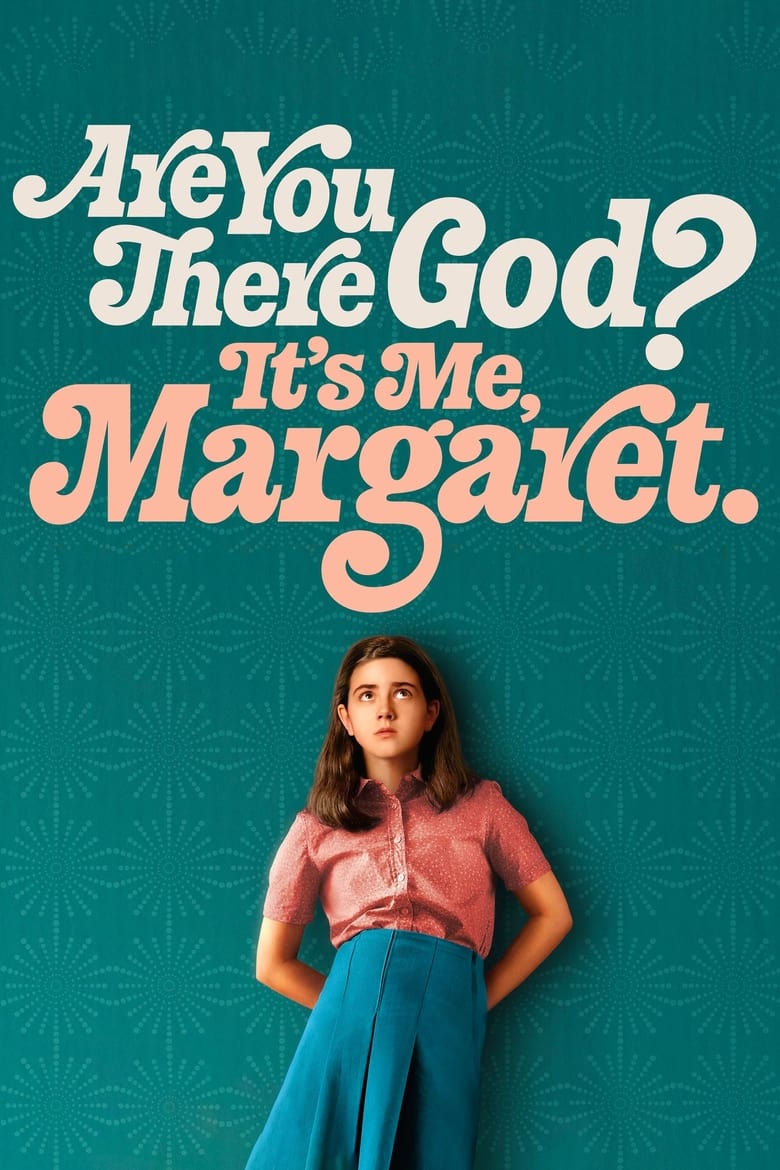

Eleven-year-old Margaret Simon leaves New York City when her father takes a job in a New Jersey suburb in 1970. She misses her grandmother and old friends, then joins Nancy, Gretchen, and Janie at a new school. Margaret tries to keep up as her body changes and the girls begin talking about breasts, periods, and boys. She also wonders which, if any, religion feels right for her, while her parents face old hurt with her Christian grandparents. Janie is one of Margaret's close friends, and the film shows her mother using a hot comb on Janie's hair. Margaret visits Jewish and Christian services while deciding what she believes for herself. Her mother Barbara leaves art teaching after the move, takes on housework and PTA work, then returns to teaching at the end. These moments sit inside a warm story about growing up, family, friendship, and the questions Margaret carries on her own.
Community feedback
Was our 38% Woke rating accurate?
Loading review details…
Breakdown
These are the editorial factors and ratings behind our score for Are You There God? It's Me, Margaret..
Woke representation / casting
Director Kelly Fremon Craig says representation matters and that she wants stories to include people like her friends. She points to Janie's mother using a hot comb as a scene whose details she wanted to get right. The film casts black actors as Janie, Margaret's friend, and Freddy, a classmate. Black actor Echo Kellum plays Mr. Benedict, Margaret's teacher.
16%
Woke political dialogue
Not present. The girls talk about puberty, friends, boys, and religion.
0%
Identity-driven story themes
Not present. Margaret's story follows puberty, changing friendships, and her personal search for faith.
0%
Western institutional / cultural critique
Barbara leaves her art-teaching job when Herb's new job moves the family to New Jersey. She spends much of the year on housework and school PTA tasks while her art supplies sit in the garage. Herb stays in paid work while Barbara adjusts to her new home role. Barbara returns to art teaching at the end.
27%
Woke character or canon changes
The film adds a story for Barbara that the novel does not follow. Barbara leaves art teaching when Herb gets a new job, spends more time on home duties, and later returns to teach art. The new story focuses on her choice between work and home life.
20%
Anti-woke backlash and complaints
A few small X accounts called Lionsgate's Judy Blume interview with Dylan Mulvaney “woke.” The Washington Examiner reported Mulvaney's role in the promotion, and an American Thinker column called the pairing insulting to girls. John Nolte tied the weak opening to Blume's LGBTQ comments and the book's sexual topics, not to a woke rewrite of the film.
33%
Creator track record context
Judy Blume has opposed book bans and publicly supported LGBTQ equality. Julie Ansell supported Frameline as a place to show LGBT films. Kelly Fremon Craig has said girls and people like her friends were underrepresented in stories. James L. Brooks has given millions to Democratic campaigns and supported civil-rights and immigrant groups.
46%
Production
Movie · 2016
Two high school girls are best friends until one dates the other's older brother, who is totally his sister's nemesis.

Movie · 2025
An eccentric lottery winner who lives alone on a remote island tries to make his fantasies come true by getting his favourite musicians to perform at his home.
Movie · 2017
Brigsby Bear Adventures is a children's TV show produced for an audience of one: James. When the show abruptly ends, James's life changes forever, and he sets out to finish the…

Movie · 2025
Lily Trevino unexpectedly befriends an online stranger who shares her self-centered father’s name. This new Bob Trevino’s support could transform her life.
Movie · 2018
Tony Lip, a bouncer in 1962, is hired to drive pianist Don Shirley on a tour through the Deep South in the days when African Americans, forced to find alternate accommodations and…
Movie · 2024
Fran likes to think about dying. It brings sensation to her quiet life. When she makes the new guy at work laugh, it leads to more: a date, a slice of pie, a conversation, a…
Movie · 2019
A down-on-his-luck crab fisherman embarks on a journey to get a young man with Down syndrome to a professional wrestling school in rural North Carolina and away from the…

Movie · 2024
When a construction worker unexpectedly joins a local theater's production of Romeo and Juliet alongside his estranged teenage daughter, the drama onstage starts to mirror his own…
