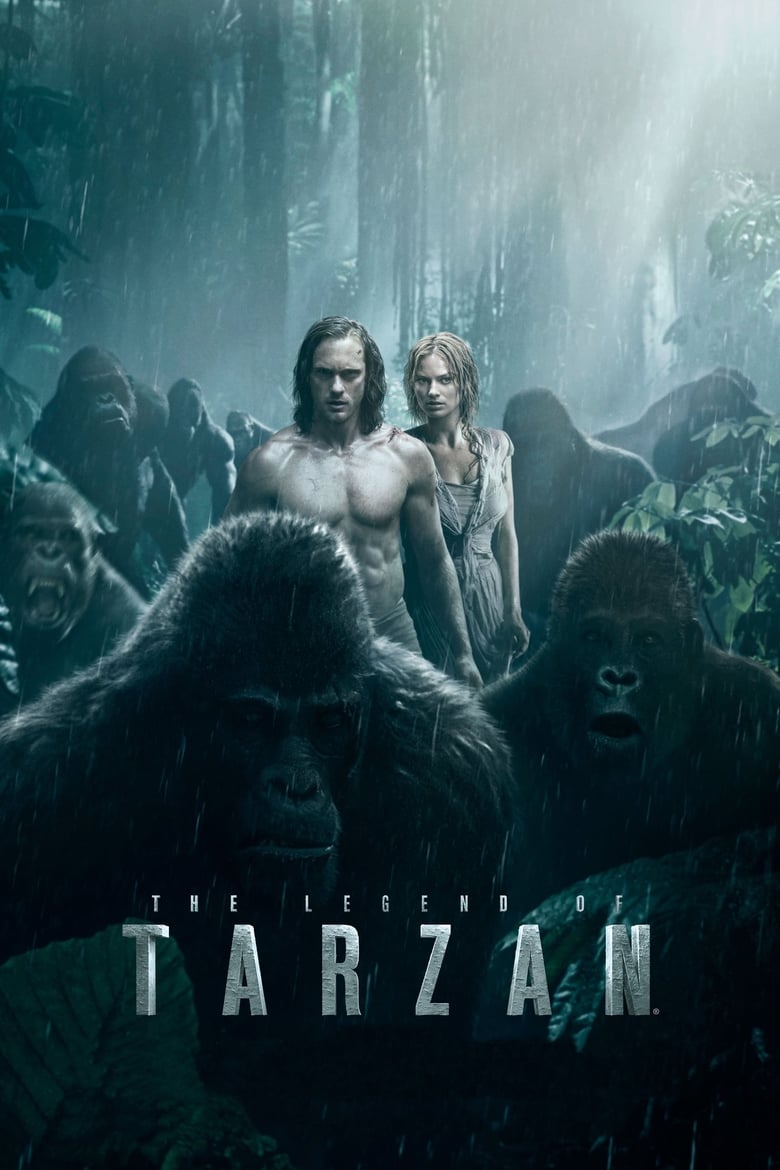

John Clayton, known as Tarzan, has settled in London with his wife Jane after years in the Congo. American envoy George Washington Williams asks John to return and investigate reports that King Leopold's agents are forcing Congolese people to work. Captain Leon Rom wants to seize the region's diamonds and build an army for the Belgian king. The trip brings John back to the animals and people he left behind and makes him face an old fight with Chief Mbonga. The film gives Jane a more active role than the familiar rescue story, as she refuses to stay in London and works to escape her captors. Tarzan still leads the main fights, while Jane helps make choices that move the rescue forward. Williams turns the slave trade into a major part of the plot, and Belgian soldiers are shown hurting villagers for the king's gain. Rom's rosary becomes a weapon, and Jane jokes about his childhood priest, giving the villain an anti-church edge. These ideas sit inside an adventure about loyalty, family, greed, and survival.
Community feedback
Was our 40% Woke rating accurate?
Loading review details…
Breakdown
These are the editorial factors and ratings behind our score for The Legend of Tarzan.
Woke representation / casting
Director David Yates called George Washington Williams the film’s real hero and said the older Tarzan stories’ racist baggage had no place in a modern film. Samuel L. Jackson plays Williams, a real black historical figure, as a leading ally. The role is also tied to the film’s period setting.
14%
Woke political dialogue
Jane answers, “Like a damsel?” when Rom tells her to scream for Tarzan. Jane also says she brought herself to the Congo and refuses to wait while John decides for her. The exchange jokes about a woman being expected to wait for a man to save her.
9%
Identity-driven story themes
Jane chooses to return to the Congo and pushes to join the mission. Jane uses a rifle and helps find a way to escape Rom’s boat. The story presents her as an active partner who can act and help rescue herself.
18%
Western institutional / cultural critique
Rom wraps a Catholic rosary around his hand and uses it as a weapon against Jane and Tarzan. Rom says a priest bought the beads for him when he was a child. Jane jokes that Rom and the priest were unusually close. The film links a Christian symbol to the villain’s cruelty.
32%
Woke character or canon changes
The film adds George Washington Williams, a real black historical figure, to the Tarzan story. Williams brings John back to the Congo and helps expose Leopold’s slave trade. Yates called Williams the film’s real hero while describing the choice as a way to leave old racist material behind.
22%
Anti-woke backlash and complaints
Several Christian reviews complained that Rom’s rosary linked Catholicism with violence. One called Jane’s priest joke politically correct. Two small X posts called the film woke or politically correct and drew little response.
20%
Creator track record context
Director David Yates has praised diversity and otherness in earlier work and spoke of current values for this film. Writer Craig Brewer has called for more representation, and casting director Lucy Bevan has supported inclusive casting. Writer John Collee’s public climate work is a milder signal. The other stored writer and producer notes report little sustained identity-driven work.
39%
Production

Movie · 2016
From DC Comics comes the Suicide Squad, an antihero team of incarcerated supervillains who act as deniable assets for the United States government, undertaking high-risk black ops…
Movie · 2001
Young hobbit Frodo Baggins, after inheriting a mysterious ring from his uncle Bilbo, must leave his home in order to keep it from falling into the hands of its evil creator.

Movie · 2022
Prince Amleth is on the verge of becoming a man when his father is brutally murdered by his uncle, who kidnaps the boy's mother.
Movie · 2016
Fearing the actions of a god-like Super Hero left unchecked, Gotham City’s own formidable, forceful vigilante takes on Metropolis’s most revered, modern-day savior, while the…

Movie · 2018
Lara Croft, the fiercely independent daughter of a missing adventurer, must push herself beyond her limits when she finds herself on the island where her father disappeared.
Movie · 2016
The peaceful realm of Azeroth stands on the brink of war as its civilization faces a fearsome race of invaders: orc warriors fleeing their dying home to colonize another.
Movie · 2017
When Mahendra, the son of Bāhubali, learns about his heritage, he begins to look for answers. His story is juxtaposed with past events that unfolded in the Mahishmati Kingdom.
Movie · 2018
The Scorpion King teams up with a female warrior named Tala, who is the sister of The Nubian King. Together they search for a legendary relic known as The Book of Souls, which…
