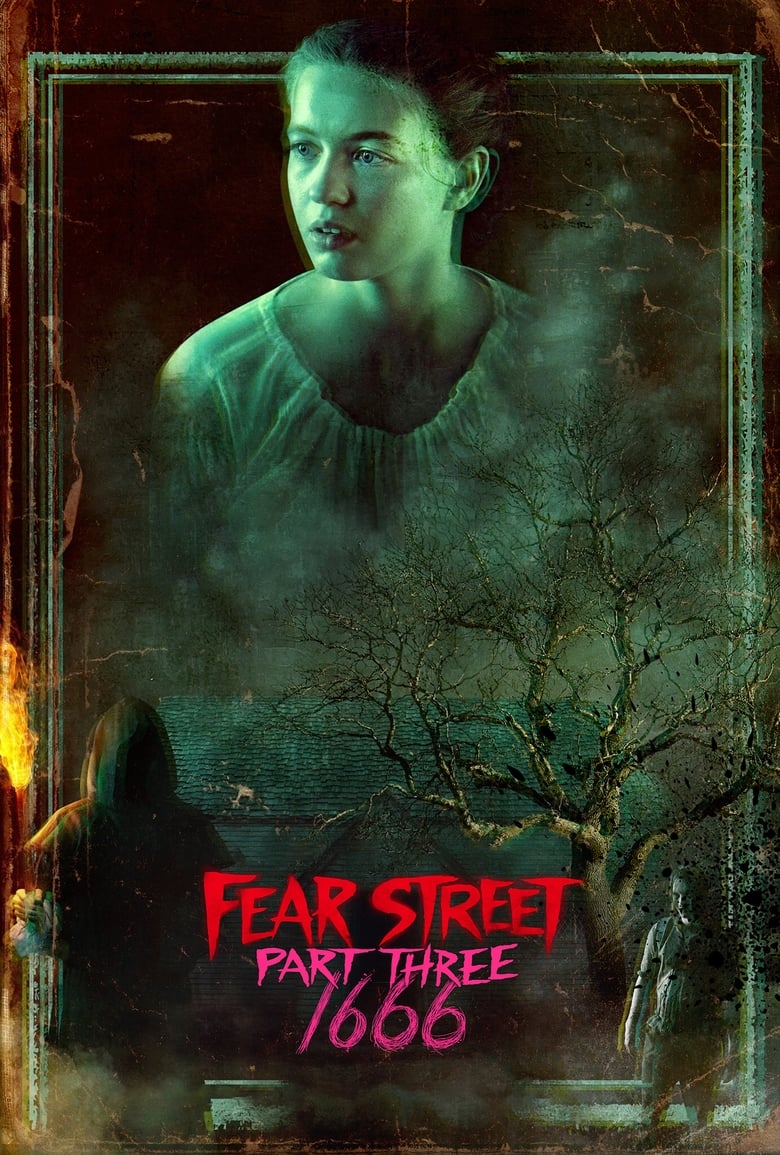

Deena Johnson is a teenager from Shadyside who touches the bones of Sarah Fier and sees the town’s past. In 1666, Sarah lives in a small Puritan settlement with her brother Henry and secretly loves Pastor Miller’s daughter, Hannah. When crops fail and children die, the frightened town blames the two women for witchcraft. The story then returns to 1994, where Deena and her friends race through a mall and hidden tunnels to stop the killings. The movie mixes folk horror, bloody slasher action, and a time-spanning mystery. The film makes Sarah and Hannah’s lesbian relationship the emotional center of both the past and present stories. The women face shame, false blame, and death because their town treats their love as a sin, while Deena’s love for Sam helps end the curse. The movie also makes a powerful man from the Goode family the source of the curse and links his family’s success to the suffering of poorer Shadyside. Its black queer heroine, repeated focus on outsiders, and criticism of religious and social power make its woke elements easy to notice.
Community feedback
Was our 95% Woke rating accurate?
Loading review details…
Breakdown
These are the editorial factors and ratings behind our score for Fear Street: 1666.
Woke representation / casting
The movie uses a diverse cast for its 17th-century Puritan setting. The main characters, Sarah and Hannah, are in a central lesbian relationship that mirrors the modern queer romance in the 1994 timeline. Casting a woman of color as the historical lead who faces persecution is a clear identity-first choice. The story places this queer romance at the very center of the narrative, giving it high representation priority over traditional horror structures.
77%
Woke political dialogue
The 1666 characters repeatedly call Sarah and Hannah’s love a sin and use witchcraft claims to punish them. The town’s leaders treat the women’s relationship as proof that evil has entered the settlement. Deena later explains that the Goode family plants evidence, trades Shadyside names to the Devil, and keeps its power through sacrifice. The dialogue carries a clear activist message, but the movie uses period language instead of long modern political speeches.
41%
Identity-driven story themes
The film builds its main mystery around a lesbian couple in 1666 and their matching 1994 relationship. Sarah is blamed for witchcraft because of her love for Hannah, and her execution drives the curse story. Deena uses Sarah’s truth and her love for Sam to expose the Goode family’s system and save the town. The film presents queer love, protection of outsiders, and resistance to inherited power as the path to victory.
88%
Western institutional / cultural critique
The Puritan leaders treat same-sex love as a sin and use religious fear to support the witch hunt. The Goode family uses town offices and the police to protect its power while Shadyside suffers. The 1994 story says the police planted evidence against Martin and shows the sheriff defending a family secret. The film links Sunnyvale’s comfort to Shadyside’s deaths, so its criticism reaches religion, law enforcement, inherited power, and class.
68%
Woke character or canon changes
The film turns the Fear Street books into a new shared origin story for Sarah Fier, the Fier family, and the Goode family. The film makes Sarah’s secret love for Hannah a key reason she is accused and executed. Phil Graziadei said the books had no clear queer representation and that the films used this chance to make it part of the story. Netflix says the films are not direct versions of one book and that the main mythology was created for the movies.
74%
Anti-woke backlash and complaints
Small reviews and viewer posts called the film or trilogy woke because of the black lead, lesbian romance, and criticism of religious and social power. Moria Reviews made the clearest casting complaint by saying the 1666 setting was historically false because of Sarah and Henry’s race. Other small reviews on Codex Mortis, Letterboxd, Cinafilm, and MovieMeter made similar complaints. The comments had little reach, and no boycott, review-bombing push, or large conservative campaign was found.
32%
Creator track record context
Leigh Janiak’s stored score is 65, and her work often centers queer romance and people treated as outsiders. Phil Graziadei’s stored score is 69, and his writing is linked to strong LGBTQ+ themes. Kate Trefry’s stored score is 41 because of queer character work but limited public activism, while R.L. Stine’s stored score is 21. This title closely matches Janiak and Graziadei’s stated focus on systemic oppression and queer representation.
63%
Production
Movie · 2023
Between the events of 'Saw' and 'Saw II', a sick and desperate John Kramer travels to Mexico for a risky and experimental medical procedure in hopes of a miracle cure for his…
Movie · 2016
A young nurse takes care of an elderly author who lives in a haunted house.
Movie · 2021
Madison is paralyzed by shocking visions of grisly murders, and her torment worsens as she discovers that these waking dreams are in fact terrifying realities with a mysterious…
Movie · 2016
Father and son coroners receive a mysterious unidentified corpse with no apparent cause of death. As they attempt to examine the "Jane Doe," they discover increasingly bizarre…
Movie · 2026
The host of a popular paranormal podcast becomes haunted by terrifying recordings mysteriously sent her way.
Movie · 2017
After a mysterious global crisis, a young girl is left alone to hide from a malevolent power that stalks her home.
Movie · 2022
While quarantining at her family's lake house during the pandemic, Parker and her best friend are threatened by an unexpected visitor.
Movie · 2021
Reeling from the unexpected death of her husband, Beth is left alone in the lakeside home he built for her. Soon she begins to uncover her recently deceased husband's disturbing…
