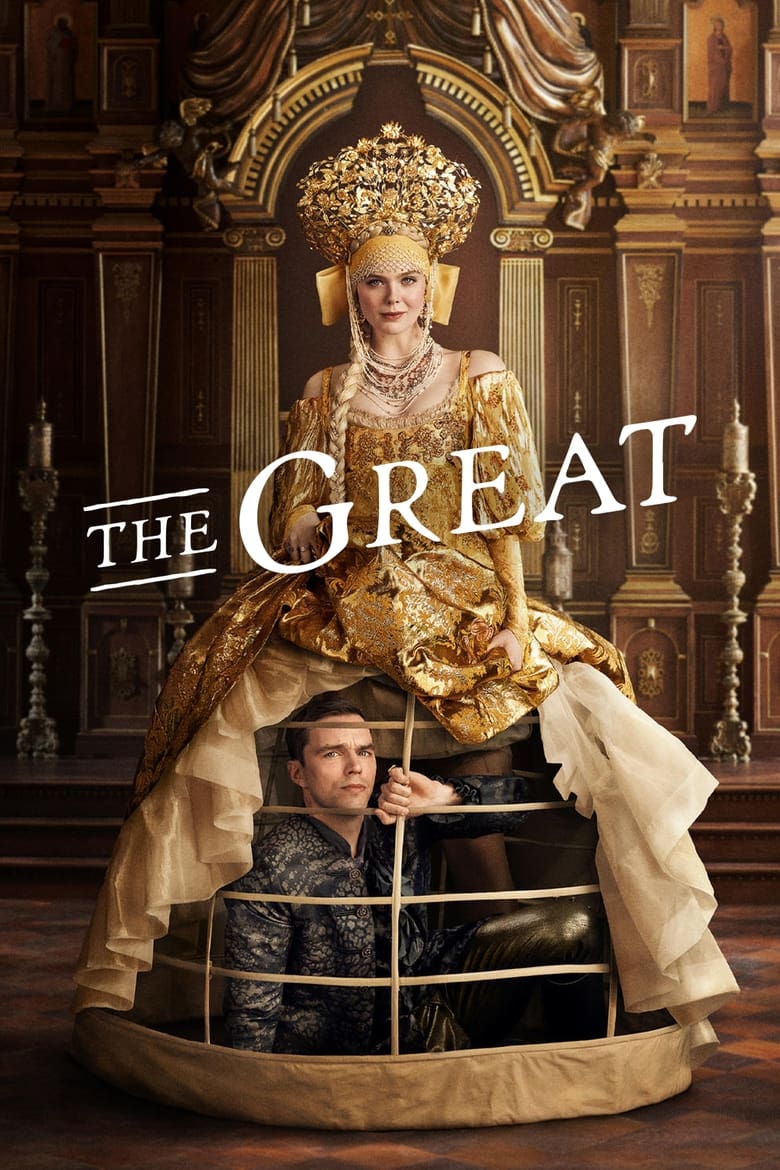

2020–2023 · Based on 3 seasons through May 12, 2023 ·
The Great follows Catherine, a young German woman sent to 18th-century Russia for an arranged marriage to Emperor Peter. Peter is cruel, childish, and obsessed with pleasure, while Catherine wants books, science, education, and a better country. She joins Marial, Orlo, and other court allies to plan a coup, then struggles to rule after taking power. The show uses sharp jokes, modern speech, sex, violence, and wild changes to history.
The show makes Catherine's fight for power as a woman a major part of all three seasons. It shows her pushing for girls' education, freer laws, an end to serf abuse, divorce, and a wider voice for peasants and merchants. Men often appear as foolish, violent, or entitled, while women fight over marriage, work, family, and control of their own lives. The court also includes deliberate colorblind casting and visible same-sex and sexually fluid characters, especially Orlo and Aunt Elizabeth.
Community feedback
Was our 68% Woke rating accurate?
Loading review details…
Breakdown
These are the editorial factors and ratings behind our score for The Great.
Woke representation / casting
The court uses repeated colorblind casting in named and important roles, including Sacha Dhawan as Orlo, Bayo Gbadamosi as Arkady, and other actors of color. The casting team said period accuracy was set aside, and Elle Fanning said the show wanted people today to relate and feel represented. The main royal couple remain white, so the message is a strong supporting pattern rather than the whole plot.
45%
Woke political dialogue
The show repeatedly gives Catherine a reform program. She argues for girls' education, science, vaccination, an end to serf abuse, divorce, and a wider voice for ordinary people. The court and church often block or mock these ideas. The show presents the reforms as good, but it uses jokes and period fantasy instead of long modern speeches.
45%
Identity-driven story themes
The main story follows a woman trying to rule a country that expects women to obey men. Catherine, Marial, Elizabeth, and other women fight over education, marriage, pregnancy, sex, work, and control of the court. Season 2 openly links women's choices to patriarchy, and season 3 shows female rage, female friendship, and Catherine's struggle to keep her power. Orlo has sex with both a man and a woman before deciding that books matter more, while Elizabeth openly pursues partners of more than one gender.
58%
Western institutional / cultural critique
Peter and many male nobles are shown as childish, violent, sexually selfish, or unable to lead. Women are often the people who question forced marriage, male entitlement, and rules that keep them from reading or ruling. The church is often shown as a rival power that wants money and control, and Catherine tries to limit it. Catherine and the women around her also act selfishly, so the criticism is sharp but not a simple message that women are good and men are bad.
48%
Woke character or canon changes
The show rewrites real figures and events for comedy, but most changes serve its openly fictional style. The clearest identity-focused change is Aunt Elizabeth, a real Russian ruler who is shown as openly pursuing men and women. The series also makes Catherine's reform goals and women's schooling central, though those ideas have roots in the real Catherine's life. This is a meaningful change to history, but it is mostly limited to a supporting character and the show's broad satire.
25%
Anti-woke backlash and complaints
Some right-leaning coverage called the show a modern feminist or social-justice version of Catherine and objected to its politics and sexual content. Online discussions also questioned the colorblind casting of non-white nobles in 18th-century Russia. Many other viewers accepted the choice because the show openly rejects historical accuracy. The complaints I found were scattered, with no large boycott or lasting campaign.
25%
Creator track record context
Tony McNamara's background centers on satire, women in power, and old systems being mocked, but it does not show a strong activist persona. Most listed writers, directors, and producers have no clear identity campaign in their public work. Casting director Dixie Chassay has a strong diversity record, and director Zetna Fuentes has public diversity work. The group gives the show moderate progressive context, but it is not mainly an activist team.
31%
Production

TV Show · 2024
The life of an American woman living in Kyoto, Japan, is upended when her husband and son disappear in a mysterious plane crash.
TV Show · 2019
Burned out on life, Miles undergoes a strange procedure at a strip mall spa -- and wakes to find he's been replaced by a better version of himself.

TV Show · 2019
A paragliding mishap drops a South Korean heiress in North Korea -- and into the life of an army officer, who decides he will help her hide.

TV Show · 2016
Rebellious Mickey and good-natured Gus navigate the thrills and agonies of modern relationships.
TV Show · 2020
New passions. New fashions. New Emily? A plucky American marketing whiz spreads her wings in life and love after landing her dream job in Paris.

TV Show · 2016
In his funky California beach enclave, Chip's the go-to guy for personal insights. But he isn't quite as enlightened when it comes to his own baggage.

TV Show · 2019
A group of working-class friends finding unconventional ways to win at life in suburban northern England. These lads have dealt, scammed, bribed and conned their way through…
TV Show · 2025
After an embarrassing incident at work, suburban family man William Ronald Trosper finds himself investigating a far-reaching conspiracy.
